Protein Foundation Model
PhaseFlow
A unified model for multi-modal and multi-scale phase-separating protein understanding and design.
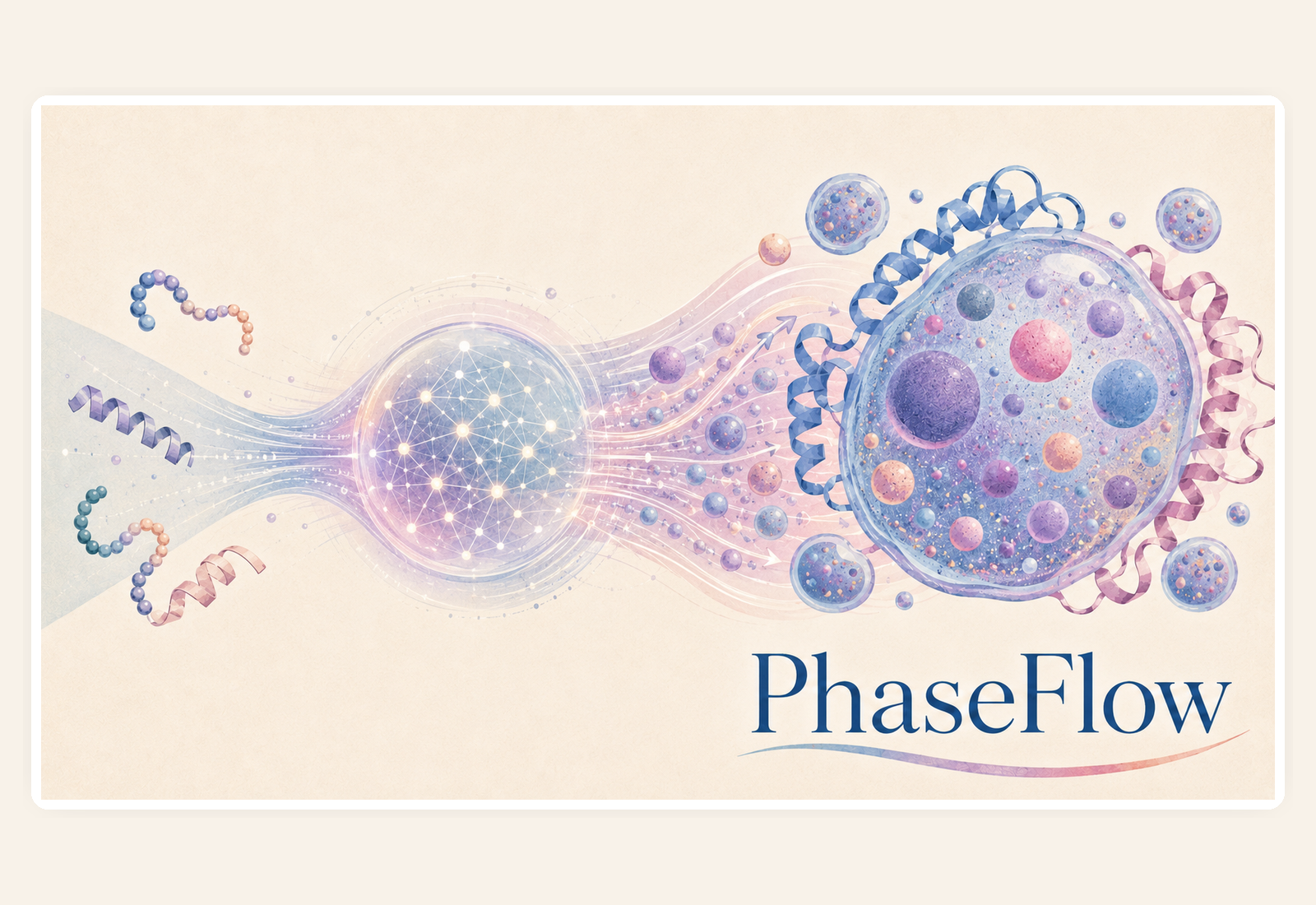
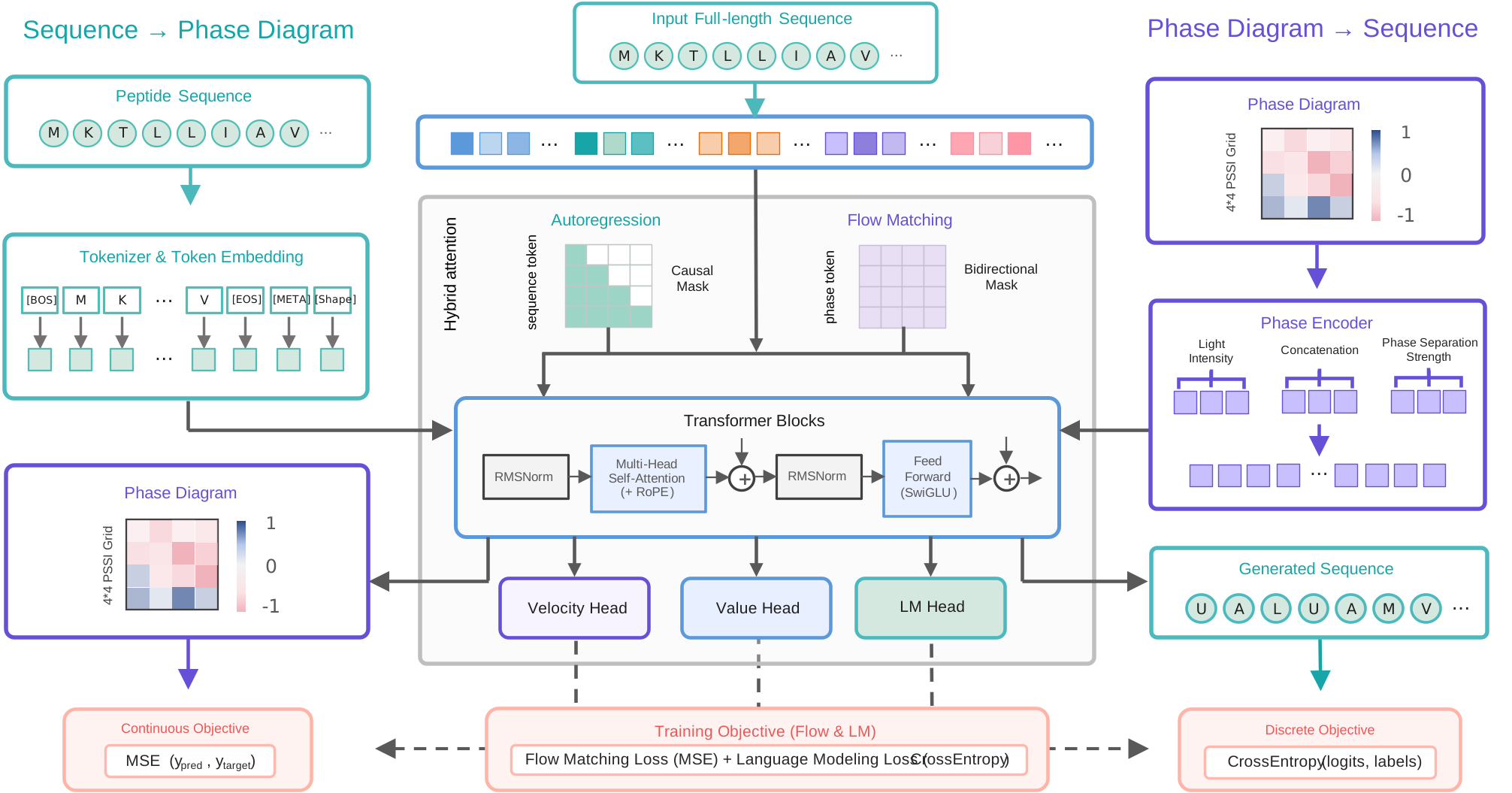

PhaseFlow is a multimodal generative model for liquid-liquid phase separation (LLPS). It connects full-length protein understanding, peptide-scale phase diagrams, and mutation-level optimization in one workflow.
The core peptide module jointly models amino acid sequences and 4x4 PSSI phase diagrams. A Transfusion-style Transformer combines autoregressive sequence modeling with Conditional Optimal Transport Flow Matching over continuous phase values, enabling both sequence-to-phase prediction and phase-to-sequence design. A full-length GNN-Transformer branch then brings in long-range sequence, structural, disorder, and peptide-derived local phase evidence for protein-scale LLPS prediction and droplet-promoting region scanning.
What It Enables
- Predicting full 4x4 LLPS phase diagrams from peptide sequences.
- Generating novel peptide sequences conditioned on target phase behavior.
- Predicting full-length protein LLPS propensity.
- Scanning proteins for droplet-promoting regions.
- Scoring mutation effects and steering in-silico directed evolution toward desired phase profiles.
My Role
I worked across dataset processing, model design, training and evaluation, inference-time optimization, design workflows, and scientific visualization. I also helped shape PhaseFlow into a multi-scale system that links protein-level prediction, peptide-level generation, and mutation-level optimization.
Release
The public repository provides the PhaseFlow codebase for training, inference, sequence-to-phase prediction, phase-conditioned sequence generation, and directed-evolution style optimization.


